

On December 9, 2023, the latest original research article “A breast cancer classificationimmune landscape analysis based on cancer stem-cell-related risk panel” by the research team of Zhang Taolan from the Department of Pharmacy of the First Affiliated Hospital of University of South China was published online in the Top journal npj Precision Oncology (a journal in the Q1 of CAS, IF=7.9). Hu Haihong, a masters student in the class of 2021 from the School of Pharmaceutical Science of University of South China,Dr. Zou Mingxiang from the First Affiliated Hospital of University of South China are the first authors of this article. Dr. Zhang Taolan is the sole corresponding author,the First Affiliated Hospital of University of South China is theprimaryaffiliationforthe first authors and the corresponding author.
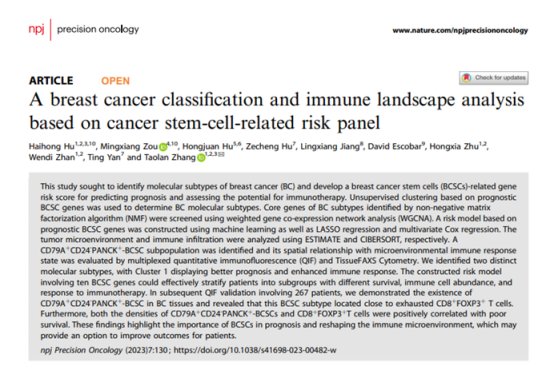
Statistical data released by the International Agency for Research on Cancer (IARC) of the World Health Organization (WHO) shows that there were approximately 2.3 million new cases of breast cancer worldwide in 2020, with a female mortality rate as high as 15.5%—breast cancer has become the leading “beauty killer” threatening womens liveshealth! Research indicates that breast cancer stem cells are the source of the heterogeneity of breast cancer cells. Such cells possess strong tumorigenic properties, self-renewal capabilities,multi-differentiation potential, leading to malignant phenotypic switching such as treatment resistance, tumor recurrence,metastasis. This study identified two molecular subtypes related to breast cancer stem cells through machine learning methods,based on this, constructed a prognostic model for breast cancer. The specificityaccuracy of the model were validated in multiple cohorts, demonstrating its good predictive efficacy for the overall survival of breast cancer patients. In addition, this study also discovered a new breast tumor stem cell subpopulation, CD79A+CD24--Panck. Through methods such as multiplex quantitative immunofluorescence (QIF), it was revealed that this breast cancer stem cell subpopulation has an effect of inducing exhaustion on CD8+ T cells, providing new directions, ideas,strategies for precise intervention to improve the clinical immunotherapy outcomes of breast cancer.
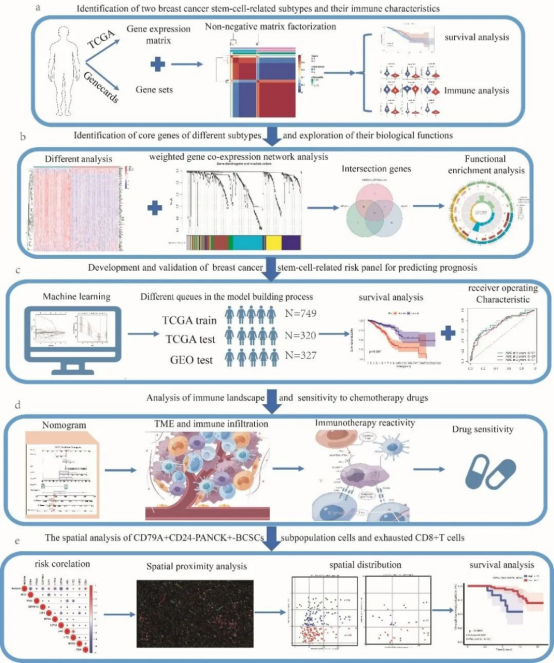
Overview of the research process related to this study
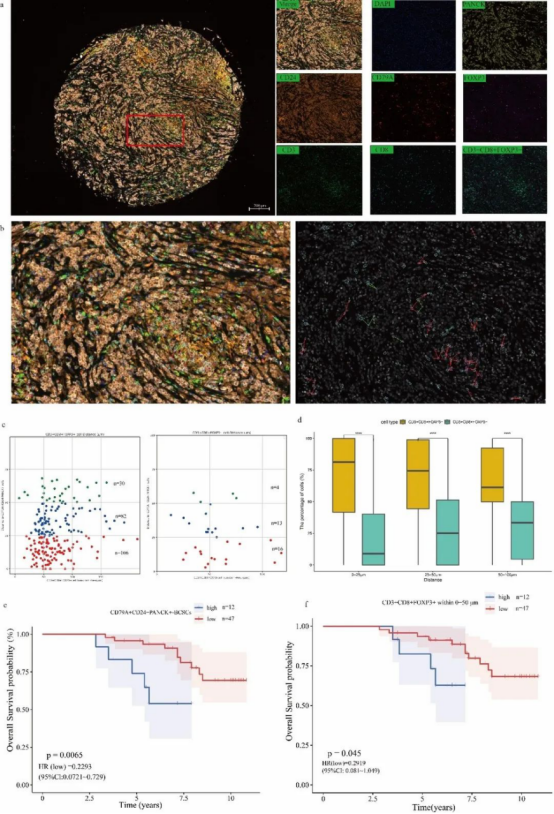
Representative research results
This study was funded by the National Natural Science Foundation of China, the Natural Science Foundation of Hunan Province, the Huxiang Young Talent Program, the China Scholarship Council, the 4310 Research Project of the University of South China, the Hengyang ScienceTechnology Innovation Plan, etc.
Link to original article:https://www.nature.com/articles/s41698-023-00482-w)